Communal Luxury by Kristin Ross
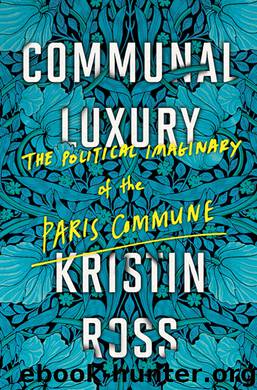
Author:Kristin Ross
Language: eng
Format: epub
Publisher: Verso Books
In its “Declaration to the French People” of April 19—the most official of the documents outlining the Commune’s goals and processes—the Commune emphasized its intention of guaranteeing the “absolute autonomy” of every local commune, and called on the farmers and peasants to be their “ally” in the struggle for this “communal idea.”49
Concluding his discussion of the Paris Commune’s relation to the provinces, Marx comments that what Thiers and company fear most, even more than they fear the emancipation of the urban proletariat, is the emancipation of the peasants. A few years later, Marx would return to the narrative of Thiers and company again, and recount their activities in a new setting. In remarks made in the French National Assembly in 1875, the same characters who suppressed the Paris Commune so violently four years earlier are heard denouncing communal property in colonized Algeria as a danger, since it is “a form which supports communist tendencies in the [people’s] minds.” French colonial policy in Algeria, it seems, is governed by the same impetus that drove the brutal suppression of the Commune. Thiers, after all, was the author of a philosophical treatise entitled De la propriété; these representatives of the French bourgeoisie, Marx observes, “are unanimous on the goal: [the] destruction of collective property.”50
In Marx’s work from the Paris Commune on, there is a renewed interest in the peasantry, and especially the peasantry outside Europe, as well as in the persistence in the present of pre-capitalist and non-Western forms of communal property and communal labor, particularly in India, Algeria, and Latin America. As Teodor Shanin and others have made clear, Marx after 1871 distances himself from a revolutionary perspective that depends on capitalist “progress,” whether technical or social-structural.51 The Commune brings the insight that the urban working class needs an alliance with the peasantry that is based on “living interests” and “real needs.” That is, if the “living interests” and “real needs” of rural and non-European people had become more visible to Marx, it is important to recall that they were visible for him in a relational, “non-essentialist,” we might say, way—they are perceived only in their relation with urban working-class life under capitalism. For Marx, the Paris Commune entailed a “practical learning of extending relations”—the phrase is Raymond Williams’s—from the city to the French countryside, and to the countryside and the world outside Europe.52 The lived reality of the Russian countryside could now be perceived in its particularity not as lagging, in a (Darwinian) evolutionary schema, but as part of a global interdependence of interlocking social transformations: town and country on a worldwide scale.
Download
This site does not store any files on its server. We only index and link to content provided by other sites. Please contact the content providers to delete copyright contents if any and email us, we'll remove relevant links or contents immediately.
| Anthropology | Archaeology |
| Philosophy | Politics & Government |
| Social Sciences | Sociology |
| Women's Studies |
Nudge - Improving Decisions about Health, Wealth, and Happiness by Thaler Sunstein(7712)
The Fire Next Time by James Baldwin(5454)
iGen by Jean M. Twenge(5419)
Adulting by Kelly Williams Brown(4582)
The Sports Rules Book by Human Kinetics(4396)
The Hacking of the American Mind by Robert H. Lustig(4387)
The Ethical Slut by Janet W. Hardy(4261)
Captivate by Vanessa Van Edwards(3842)
Mummy Knew by Lisa James(3695)
In a Sunburned Country by Bill Bryson(3546)
The Worm at the Core by Sheldon Solomon(3490)
Ants Among Elephants by Sujatha Gidla(3469)
The 48 laws of power by Robert Greene & Joost Elffers(3296)
Suicide: A Study in Sociology by Emile Durkheim(3024)
The Slow Fix: Solve Problems, Work Smarter, and Live Better In a World Addicted to Speed by Carl Honore(3014)
The Tipping Point by Malcolm Gladwell(2930)
Humans of New York by Brandon Stanton(2876)
Get What's Yours for Medicare: Maximize Your Coverage, Minimize Your Costs by Philip Moeller(2761)
Handbook of Forensic Sociology and Psychology by Stephen J. Morewitz & Mark L. Goldstein(2708)
